Should Baby Panda World Replace a Child’s Favorite Game?
 Analysis by Appyee
Switching to Baby Panda World-Learning Game is less like replacing one game with another than changing the shape of a child’s play session. If a familiar app has one clear routine, Baby Panda World asks children to move among many small activities instead. That breadth can make it easier to keep a curious preschooler engaged, but it also changes what parents need to supervise: less repetition of one task, more choosing, browsing, and stopping. My verdict is to test it as a gradual addition, not assume it should immediately replace a favorite.
Why consider a switch?
The strongest reason is variety. A child who has learned the rhythm of a cooking game such as Cooking Mama: Let’s cook! may enjoy its clear recipe-to-result loop, but eventually want a different kind of pretend play. Baby Panda World gathers assorted learning and play activities around the Baby Panda world, giving a child more ways to explore without requiring a new app for every change of mood.
That variety matters most in short, unpredictable stretches of family life. A child might want a quick activity before dinner, then lose interest and ask for something else. A collection of small experiences can meet that changing appetite better than a tightly focused game. The appeal is not that every activity is deeper; it is that the next one may feel different enough to restart attention.
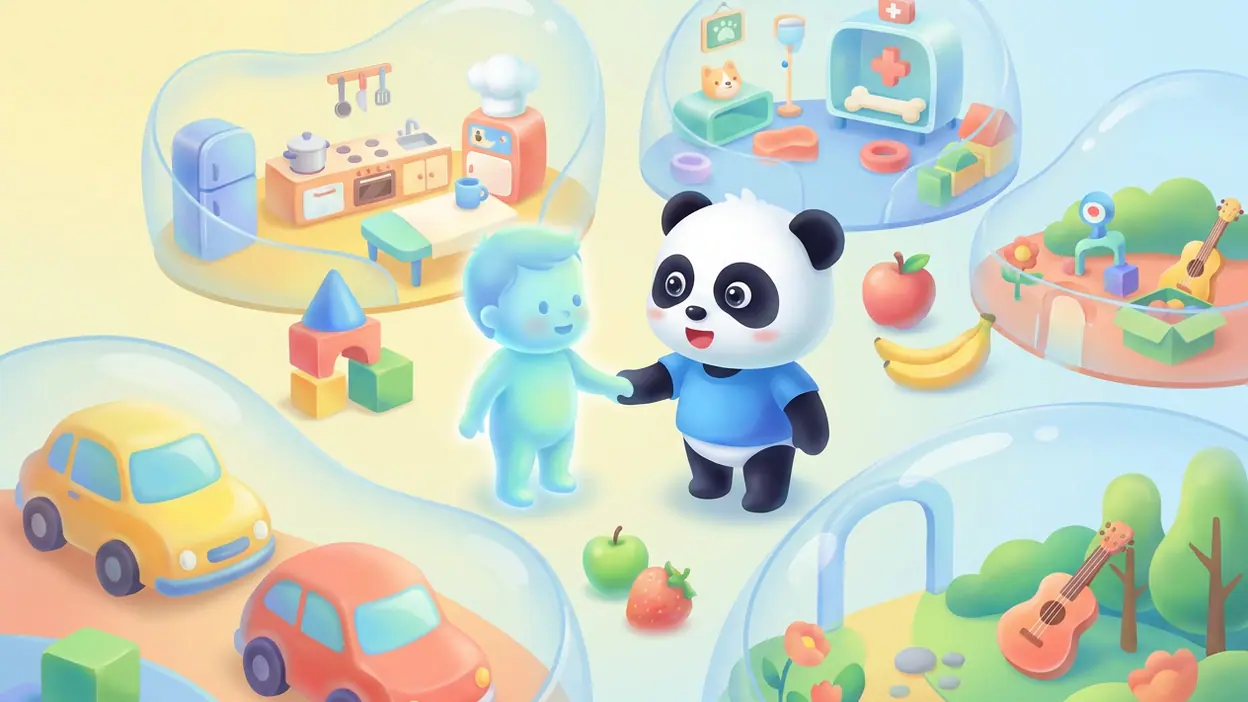
There is also a useful distinction between a world and a single scenario. Baby Panda’s Town: Hospital has a recognizable setting and role-play premise. Baby Panda World is the broader option for a child who is not ready to commit every session to the hospital, a kitchen, or a coloring page. It is a change in the menu of play, not necessarily a better version of any one activity.
The first habit that changes
The first adjustment is likely to be choosing what to do. In a focused game, the child can often open it and fall straight into a familiar loop: follow a sequence, complete a task, see the result, repeat. In Baby Panda World, the first decision is which activity to enter. That extra choice can feel empowering, but it can also turn a quick play break into a tour of options.
Parents should watch the opening minutes rather than judge only by how long the game keeps a child busy. Does the child select an activity independently, or repeatedly ask an adult to choose? Do they settle into play, or bounce from one activity to the next? Those observations tell you whether the broader structure suits your child’s attention and confidence. A game with more doors is only helpful if the child can comfortably pick one.
The play rhythm changes too. Baby Panda World is better approached as a sequence of compact visits than as a single long campaign. A child may complete one small task, look around, and choose another; the satisfaction comes from switching contexts as much as mastering a particular mechanic. That makes it adaptable, but less predictable than a game whose appeal rests on repeating one polished routine.
Setup and migration facts
Do not treat this as a data migration. There is no basis here to promise that progress, saved preferences, or activity history from another game can be imported into Baby Panda World. A switch should mean installing and trying a separate game, then deciding which app remains part of the child’s routine. Keep the old app available during the trial if its progress or familiar setup matters to your family.
Before settling in, check the current store listing for device requirements, age guidance, availability, and any purchase or privacy details relevant to your household. Those facts can vary by platform, region, and version, so they are worth verifying on the actual iOS or Android device rather than relying on a general description. Also check whether the game behaves as you expect without a connection if offline use matters; do not assume every activity is available in every circumstance.
For a low-friction start, introduce the game when there is time to explore together. Let the child try a couple of activities, point out how to return to the wider selection, and agree on a natural stopping point. You are not transferring an account or rebuilding a library. You are helping a young player learn a new set of routes through a larger play space.
The relearning cost
Relearning is modest in mechanics but real in orientation. A young child may recognize familiar visual cues and simple touch interactions, yet still need help understanding where one activity ends and another begins. The important learning curve is not a complex control scheme; it is the map of choices. An adult may need to sit nearby until the child can find a preferred activity and leave it without becoming stuck in the selection flow.
There is a parent-side learning cost as well. In a single-purpose game, you quickly know what the child is practicing and what the session looks like. A broader collection asks you to inspect several activities before deciding which ones suit your child’s age, interests, and tolerance for stimulation. Spend a little time exploring first. That is more useful than assuming that the word “learning” means every activity has the same educational value.
Compared with Coloring & Learn, for example, Baby Panda World is not simply a replacement for the quiet, focused act of coloring. It broadens the session into different kinds of play. If drawing is what reliably calms your child, the extra variety may be beside the point. Switching should solve a real problem in the existing routine, not just add a larger collection for its own sake.
What improves immediately
The immediate gain is a wider choice of mood and activity. When a child is finished with one kind of task, there is another route to try without leaving the Baby Panda setting. That can reduce the familiar cycle of reopening the same favorite game, getting bored, and asking for a different app. The world feels more like a play shelf than a single toy, and that is its most practical advantage.
There is a replay benefit in that breadth. A focused game often earns repeat visits by making the same loop satisfying to do again. Baby Panda World can earn them through changing the activity from one visit to the next. The child’s curiosity becomes part of the replay value: what else is here, and what happens if I choose that? This is a softer hook than a score chase, but it can fit preschool play well.
Variety also gives parents a chance to notice emerging preferences. A child who drifts toward pretend scenarios may want role-play; another may prefer activities with clear, immediate outcomes. The game can act as a sampler, helping you see what holds attention. That does not make it a formal learning assessment, and it should not be treated as one. Its value is observational and practical.
What may be lost
The trade-off is focus. A child attached to a familiar routine may miss the comfort of knowing exactly what happens next. More options can mean more transitions, and transitions are not automatically fun for a young player. If your child tends to become frustrated when asked to choose or stop, a narrower game may be easier to manage, even if its content is less varied.
There is also a risk of shallow sampling. A child can browse several activities without spending long enough in any one to build confidence or enjoy repetition. Parents who value a calm, sustained task may find a dedicated alternative more reliable. Likewise, if the child’s favorite part of Cooking Mama is the satisfying sequence of preparing and finishing a recipe, Baby Panda World should not be expected to reproduce that exact rhythm across its broader collection.
Finally, familiarity itself has value. A well-loved app may offer a smooth, low-conflict transition into play because the child knows where to tap and what success looks like. Replacing that dependable ritual with novelty can make a routine less convenient before it becomes more interesting. Keep the old favorite if it still serves a purpose.
A parallel-use strategy
For the first week, treat Baby Panda World as a second option rather than the new default. Offer it at a time when the child has room to explore, and keep the old game available for the situations where its predictable loop is useful. Do not switch back and forth every few minutes; give each session enough time for the child to understand its own rhythm.
A simple household rule can make the comparison fair: choose one activity or one short visit, then stop when that play feels complete. Watch whether the child can navigate without constant adult direction, whether the variety reduces requests for another app, and whether ending the session is manageable. These are better measures than raw screen time or the number of activities opened.
After several tries, ask the child which game they want and notice whether the answer changes by circumstance. They may choose Baby Panda World when they want novelty and a focused app when they want a known routine. That is not a failed switch. It is evidence that the games serve different needs, and parallel use may be the sensible outcome.
Who should switch, and who should stay?
The best switching candidate is a preschool-age player who tires of repeating one kind of activity, enjoys exploring choices, and can handle gentle transitions between small play experiences. The parent should be comfortable supervising the first few visits and checking current store information before making the game a regular part of the routine. For that family, variety with a familiar world around it is a meaningful reason to give Baby Panda World a try.
Stay put if the existing app already fits the child’s needs, if its focused loop helps keep play calm, or if the child becomes unsettled by menus and frequent changes. A child who loves the hospital role-play in Baby Panda’s Town: Hospital may have no reason to trade that clear premise for a broader set of activities. A wider game is not automatically a better one, and adding another app can create more choice than your household wants.
So make the switch only when you can name the friction you want to remove: boredom with repetition, a need for more kinds of play, or a desire to explore what holds your child’s attention. Try Baby Panda World alongside the familiar game, observe the child rather than the store description, and let the results decide. Baby Panda World-Learning Game is most convincing as a flexible play collection, not a universal replacement for focused favorites. If its extra choice makes sessions easier to start without making them harder to end, keep it in rotation; otherwise, staying with the game your child already knows is a perfectly good decision.


