Bubble Witch 3 Saga Makes Every Shot Count
 Analysis by Appyee
The best moment in Bubble Witch 3 Saga is often the half-second before a shot: a cluster hangs just out of reach, the right color is waiting in the launcher, and a bank off the wall could bring the whole lot down. That small calculation is the game’s real magic. King’s bubble-shooter is easy to read but surprisingly good at making each move feel consequential, wrapping familiar arcade play in a warm, storybook world that makes “one more level” an unusually persuasive promise.
This is not a reinvention of the genre. It is a carefully tuned version of a simple pleasure: aim, fire, match three or more bubbles, and watch the board change. The appeal lies in the details around that loop: the trajectory you can adjust, the awkward color mix that forces a rethink, the satisfying cascade when a single well-placed shot clears a hanging group. For anyone looking for a puzzle game that works in short bursts yet leaves room for clever play, Bubble Witch 3 Saga earns attention without asking for a long tutorial or a major time commitment.
A quick spell, with a little thought behind it
The opening hook
The first levels get to the point. You take aim at a crowded ceiling of colored bubbles and learn the central rule by doing: connect matching colors, clear space, and keep the board from pressing down on you. The controls are direct, the targets are visible, and the early shots land with enough feedback to make success feel immediate. It is the kind of opening that respects a player’s time.
Then the game starts giving you reasons to look twice. Some bubbles sit in awkward pockets; others are easier to reach by bouncing a shot off a wall. A direct line may clear a few pieces, while a ricochet can reach the support holding a much larger group. The difference between those outcomes is legible, so a miss usually feels like a decision you can improve rather than a rule the game kept secret.
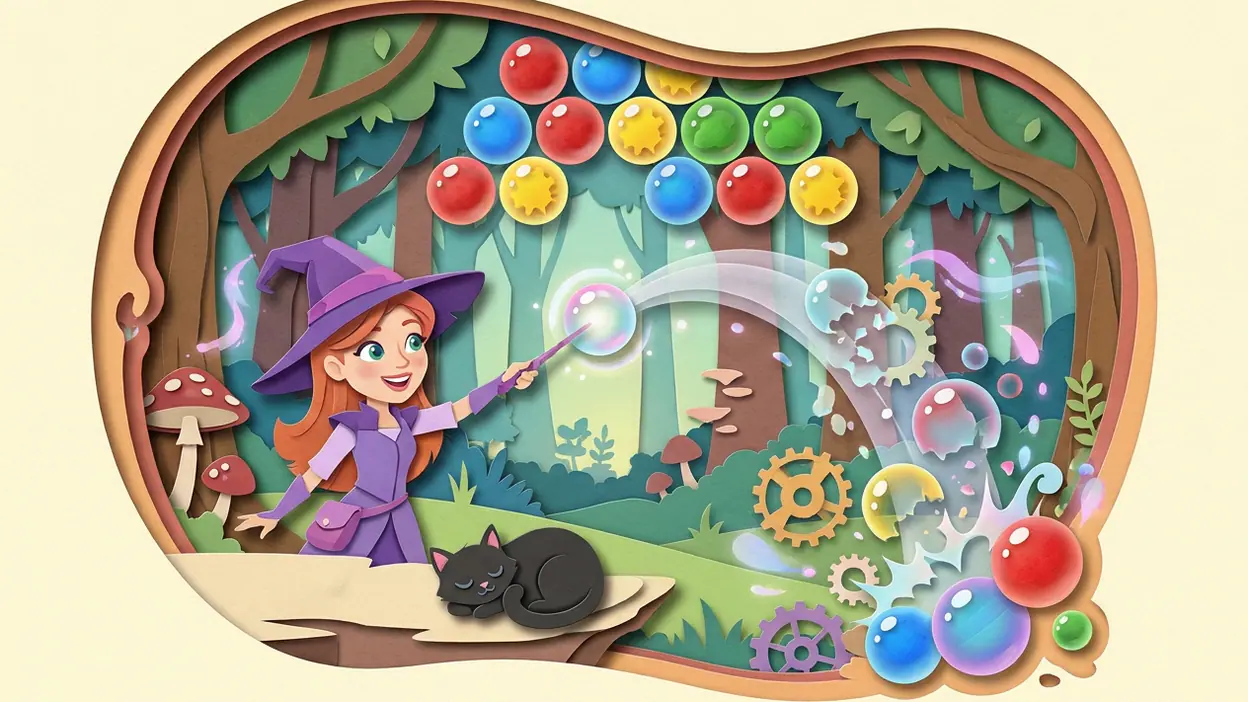
The presentation helps the lesson stick. Stella, the witch, is the familiar face guiding the adventure, with her cat Wilbur adding a playful thread to the world around the puzzles. Their presence gives the map a little personality without turning every level into a story interruption. The game knows its best invitation is still the board itself.
How the core loop feels
Each level asks you to read the bubble layout, check the next shot, and decide whether to take a safe match or set up a bigger clear. You can aim along a visible guide, and the wall-bounce option turns the edges of the screen into useful tools rather than dead space. A shot can free a trapped area, open a route to a target, or remove a dangling section all at once. When the plan works, the chain reaction has a lovely snap to it.
That rhythm keeps the game from feeling like a purely reflex-driven shooter. There is no need to fire as fast as possible; pausing to study the board is often the smarter move. At the same time, the colored launcher and the remaining space give each level a light sense of pressure. I found the most satisfying turns came from recognizing that the obvious match was not necessarily the useful one. Clearing a small group can expose a better angle, and a patient setup can make the next shot do far more work.
The loop remains approachable because its rules rarely become hard to parse. A level can still be tricky, but the challenge generally comes from arranging a shot with the bubbles available, not from memorizing a pile of exceptions. That clarity makes it easy to return after a break and pick up the feel of play within seconds.
Progression and rewards
Between levels, the map gives the game its forward pull. Progress opens new stretches of the adventure, while the changing scenery makes advancement feel like a journey rather than a stack of disconnected boards. Stella and Wilbur lend the route a light narrative frame, and the familiar cast of colorful characters and magical settings keeps the campaign from looking like the same screen repeated indefinitely.
Rewards mostly support the next attempt. Clearing a level and earning a strong result brings the clean satisfaction of finishing well; boosters and other helps can give a difficult board a nudge when your available shots are working against you. That is useful, but it also changes the texture of a win. The best victories are the ones where a better angle or a smarter sequence did the work. Assistance is welcome as a relief valve, not a substitute for the pleasure of solving the layout.
The map’s steady march is effective because every completed level puts the next one close at hand. There is always another small goal to chase, and the progress markers make it simple to see how far you have come. It is a modest reward system, but it fits the game’s short-session design.
Why sessions are hard to stop
Bubble Witch 3 Saga has a particularly effective stopping problem: most individual levels are brief, and a loss often leaves you convinced the next attempt will go differently. You can see the adjustment immediately. Aim a little higher, save a color for the hanging cluster, or use the side wall instead of wasting a shot against the center. Because a level’s puzzle is compact, the distance between failure and a plausible correction feels small.
That creates a satisfying rhythm of attempt, observation, and retry. A clean win delivers a burst of color and a visible step along the map; a near miss creates a specific question to answer. The game does not need a complicated score chase to keep attention. It makes the player curious about whether one better shot will be enough.
There is a downside to that neat rhythm. A run of stubborn boards can turn “one more try” into a slow drain, especially if you are short on helpful resources or simply want the map to move faster. The game’s structure encourages persistence, but persistence is not always the same as a fresh challenge. Taking a break is sometimes the more satisfying move.
Style, identity, and its place among puzzle favorites
The visual identity is bright, soft-edged, and deliberately welcoming. Bubbles pop with crisp feedback; backgrounds and characters keep the fantasy setting in view without obscuring the aiming puzzle. It is not a dramatic world, and it does not need to be. The mood is cheerful rather than frantic, a good match for a game that rewards a moment of concentration more than quick fingers.
That identity also separates it from other mobile puzzle habits. Sudoku - Classic Sudoku Puzzle asks for patient deduction across a grid; Block Blast! is about fitting shapes into open space; Arrows – Puzzle Escape leans on untangling movement. Bubble Witch 3 Saga instead makes geometry tactile: the angle, the bounce, and the way one group supports another are all visible in a single glance. Royal Kingdom shares the broad appeal of polished, colorful progression, but the bubble-shooter’s pleasure is more immediate and shot-by-shot.
That distinction matters. If you want the open-ended calm of a number puzzle, this is not a replacement for Sudoku. If you enjoy watching a board reorganize after a well-chosen move, its bursts of cascading bubbles have a different kind of payoff. Its strongest identity is not simply “casual puzzle”; it is the small art of making one shot count.
Who it is perfect for, and where it frustrates
This is a natural fit for players who like readable puzzles, quick levels, and a little visual reward after every good decision. It suits commutes, waiting rooms, and those short breaks when a sprawling game would be too much. It also works for players who enjoy improving through small corrections: the rules are easy to learn, but better aim and better planning can make a noticeable difference.
It is less suited to anyone who wants deep strategic systems, a serious story, or a completely frictionless progression curve. The core action stays consistent, so players who tire quickly of matching bubbles may find the map’s variety cannot fully disguise the repetition. Difficulty can also feel uneven. Some levels click into place after a quick rethink; others can seem to depend too heavily on the colors you draw or on using a booster to smooth the way.
That occasional frustration does not erase the game’s strengths, but it is worth being clear about the bargain. You get a polished, easy-to-enter puzzle loop with enough tactical choice to reward attention. In return, you accept repeated board-clearing, a campaign built to keep you advancing, and moments where a fair challenge edges toward a nudge to try again.
Why install it now
For a new player, the reason to install is straightforward: Bubble Witch 3 Saga gets to its central pleasure quickly and makes it easy to judge whether that pleasure suits you. You do not need to learn a complex system before a good shot feels good. The first levels teach the basics, the map gives you a reason to continue, and the later puzzles ask you to use the same simple tools with a little more care.
It is also a useful change of pace if your usual mobile puzzle game asks for a different kind of attention. Here, a session can be short without feeling empty. You can finish one level, leave the map, and return later without losing track of a sprawling objective. The game is most compelling when treated as a succession of small puzzles, not as a race to clear the whole campaign.
The shot is simple; the satisfaction comes from seeing the whole board before you take it. That is why the game still makes a convincing recommendation for fans of casual puzzle play. It has a clean hook, a reliable loop, and enough variety in its layouts to keep familiar mechanics lively for a good while.
Final verdict
Bubble Witch 3 Saga is a polished bubble-shooter that understands exactly where its pleasure lives: in the pause before a shot and the cascade after it lands. Stella, Wilbur, and the storybook map give the levels a friendly sense of place, while wall bounces and hanging clusters add more thought than the bright presentation first suggests. Its repetition and occasional difficulty spikes are real, and boosters can soften the line between solving and pushing through. Still, if you want a welcoming puzzle game that turns a few spare minutes into a satisfying little run of decisions, this is well worth installing. One clever shot is often all it takes to make the next level feel irresistible.


