Google Play Games Is Moving Beyond Scores
 Analysis by Appyee
A mobile game platform used to have one uncomplicated job: record achievements and keep a leaderboard. That job has not disappeared, but it no longer feels sufficient. Players now expect a place to find games, carry a recognizable identity between them, and pick up play without treating every title as an isolated download. Google Play Games is a revealing case study because it sits between the Android game store and the games themselves. Its strongest argument is not that it transforms play; it is that the category is shifting from scorekeeping toward continuity, while still struggling to make that promise feel essential.
That distinction matters. Google Play Games is not a subscription library, a streaming service, or a game in its own right. It is a companion layer for Android gaming, tied to a Google account and connected to features such as achievements, leaderboards, player profiles, and supported sign-in. The experience varies by game, region, device, and account settings, so it is better understood as infrastructure than as a single, uniform destination. Its value appears in the small moments around a game: recognizing an account, checking progress, comparing a score, or finding another title to try.
From trophy cabinet to player identity
The category baseline has moved beyond simply proving that a player finished something. People expect a game hub to make their activity legible: which games they play, what milestones they have reached, and how they compare with friends or other players. They also expect the system to stay out of the way. A profile should not create a fresh password puzzle, and an achievement should register without a detour through several menus. On a phone, where gaming sessions can be brief and interrupted, convenience is not a polish feature; it is part of the product.
There is a second expectation, less visible but increasingly important: discovery should be tied to intent. A player who has just finished a puzzle game may want another short-session diversion, not a sprawling role-playing game. A hub can help by surfacing games that fit how someone plays, rather than presenting a broad catalogue as if every title were interchangeable. Google Play Games has a role in that journey, but it does not fully own it. Google Play remains the main storefront, while individual games retain much of the control over their own progression, communities, and updates.
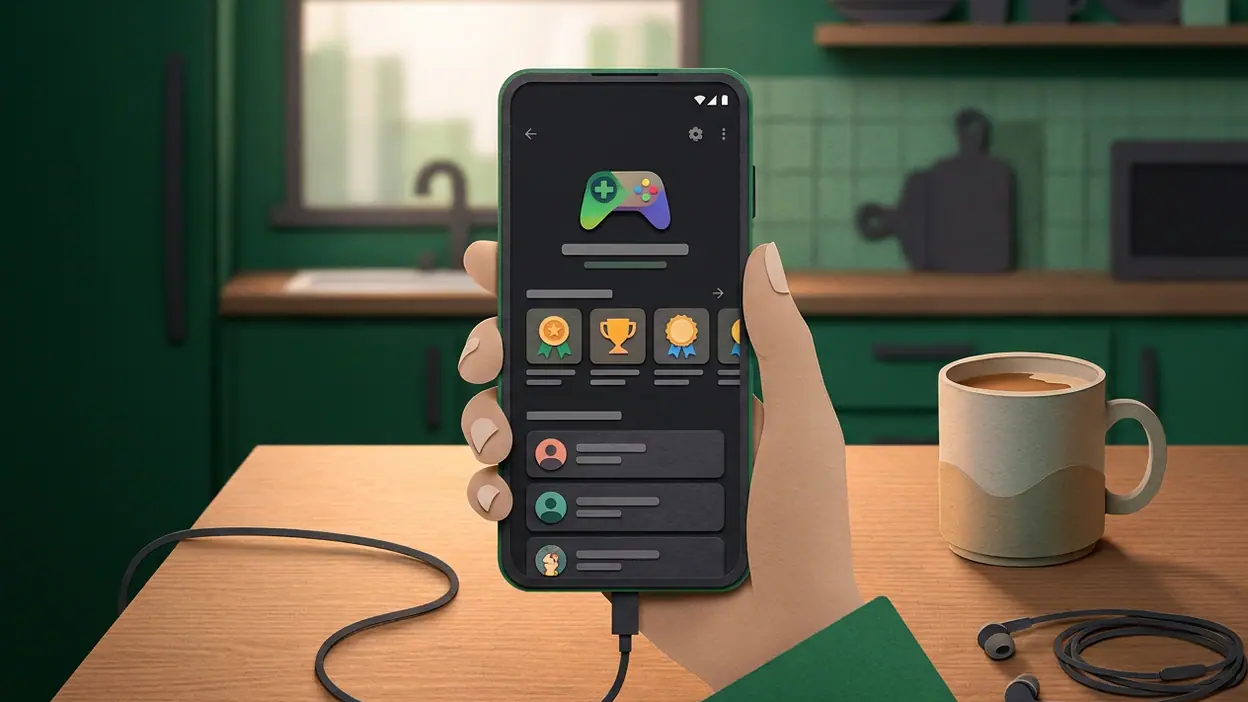
The app’s strongest signal is its attempt to make the player, rather than any single game, the durable unit. A Google Play Games profile can connect supported titles through an account, with achievements and leaderboards giving that identity visible evidence. This is a modest form of continuity, not a universal save system: cloud saves and cross-device progress depend on what each game supports. Still, the principle is sound. A player’s history should not vanish just because the latest session takes place in a different title.
That approach follows familiar conventions. Achievements turn progress into a set of named milestones; leaderboards add a social measure; profiles give play a public-facing frame. These features have been around long enough to feel almost automatic. They can provide a satisfying little pulse when a difficult objective unlocks, or make a casual score chase more compelling when a friend is within reach. But they are also easy to ignore. A badge that has no meaning inside the game can feel like paperwork, and a leaderboard without people the player knows is often just a long list of strangers.
The convention Google Play Games quietly challenges is the idea that a gaming hub must itself be the main attraction. It does not need to compete with a blockbuster game for hours of attention. Its best role is backstage: help players enter supported games, preserve some shared identity, and add a layer of recognition without interrupting the play loop. That is a useful counterpoint to platforms that try to turn every interaction into another feed, subscription prompt, or reason to stay inside the hub. The category’s future may depend less on making the hub addictive than on making it dependable.
Other entertainment products make the change in expectations easier to see, even though they solve different problems. Netflix and Prime Video train viewers to expect a service to remember what they watched and make the next choice easier. Disney+ similarly organizes a large catalogue around profiles and recognizable franchises. YouTube Kids puts parental controls and age-aware discovery ahead of a raw list of videos, while ReelShort makes quick, serialized viewing its defining rhythm. None is a direct substitute for Google Play Games, and video services do not solve game saves or achievements. Their common lesson is that a modern entertainment service is judged by what it remembers, how it helps people choose, and whether it respects the time they have.
Games add a harder requirement: progress must survive. A streaming app can resume an episode from a timestamp; a game may need to preserve a world state, a competitive rank, or dozens of hours of carefully earned equipment. The platform cannot guarantee that continuity on its own if developers implement it differently. Google Play Games therefore exposes both the promise and the limit of the hub model. A recognizable account is a start, but the player’s confidence depends on the individual game’s implementation.
The emerging standard is not a single mega-app that contains every game. It is a consistent layer that links discovery, identity, and progression while allowing games to keep their own character. Players should be able to understand what is saved, know which account is in use, and find useful recommendations without being misled into thinking that every title shares the same features. In practice, the standard needs clear signals: supported achievements, reliable sign-in, transparent save behavior, and recommendations that reflect real play rather than generic popularity.
This is where the category still lags. Google Play Games can make achievements and leaderboards available, but their usefulness depends on developer adoption and on whether a game gives them meaning. Its role in discovery is also less decisive than a dedicated catalogue might suggest; players can browse in the Play Store, follow recommendations elsewhere, or find games through friends and creators. The separation between the game hub and the store can leave a practical question unanswered: where should a player go to find the next game that actually suits them?
Continuity is another uneven patch. A profile that follows a player across supported games is valuable, but it does not mean every save transfers smoothly between devices, every game uses the same sign-in flow, or every achievement carries equal weight. Nor does a central account automatically create a lively social network. For many people, the strongest social connection is still inside a particular game, where a guild, team, or friend list has immediate meaning. A platform-level leaderboard can be useful, but it rarely replaces that local community.
For users, the consequence is a category that is helpful in flashes rather than indispensable by default. A returning player may appreciate a familiar account and a record of achievements; someone browsing for a new game may still find the hub’s value less obvious. That does not make the product a failure. It means the best test is practical: does it remove friction, make progress easier to trust, or help a person choose something worth playing? When it does, the benefit is real, even if it happens quietly.
There is also a fair warning in the platform’s restraint. A hub that promises more continuity than games can deliver risks damaging trust. Players should not infer that an achievement record guarantees a backed-up save, or that installing the app creates cross-device support for every title. Good category design makes these boundaries clear instead of hiding them behind a polished profile. The more entertainment platforms ask users to build an identity and history, the more carefully they must explain what will remain available when a device changes or a game disappears.
The next phase of mobile gaming hubs will be decided by execution, not by another badge design. They need to connect discovery with a player’s actual habits, make supported progress dependable, and give social features a reason to matter. Google Play Games points toward that future without fully delivering it: its account and achievement layer show why a player-centered platform makes sense, while its uneven ties to saves, discovery, and community reveal how much work remains.
The old trophy cabinet is no longer enough, but replacing it does not require turning a game hub into a streaming service or social network. It requires making a player’s time count across the games they already choose. The category’s real standard is trustworthy continuity: clear identity, useful discovery, and progress that stays where players expect it to. Google Play Games is most persuasive as a step in that direction, and most limited wherever the promise still depends on each game to finish the job.


