Kick & Break The Ragdoll Games Turns One Laugh Into a Replay Test
 Analysis by Appyee
Some mobile games need a tutorial to explain their appeal. Kick & Break The Ragdoll Games needs only a wobbling body, a well-timed hit and the moment before physics takes over. That simplicity is exactly why it can travel so quickly through clips and recommendations. It also sets a tough limit: the game’s first laugh arrives fast, but keeping players interested depends on whether the next attempt feels meaningfully different.
This is a trend built on instant readability rather than a deep premise. You see a ragdoll, you understand the invitation, and you want to find out what happens if you kick again. The appeal is real, but so is the durability test. Unless the game gives that impulse enough variation to grow into a satisfying loop, its most shareable moments may also be its most disposable.
Why ragdoll chaos travels
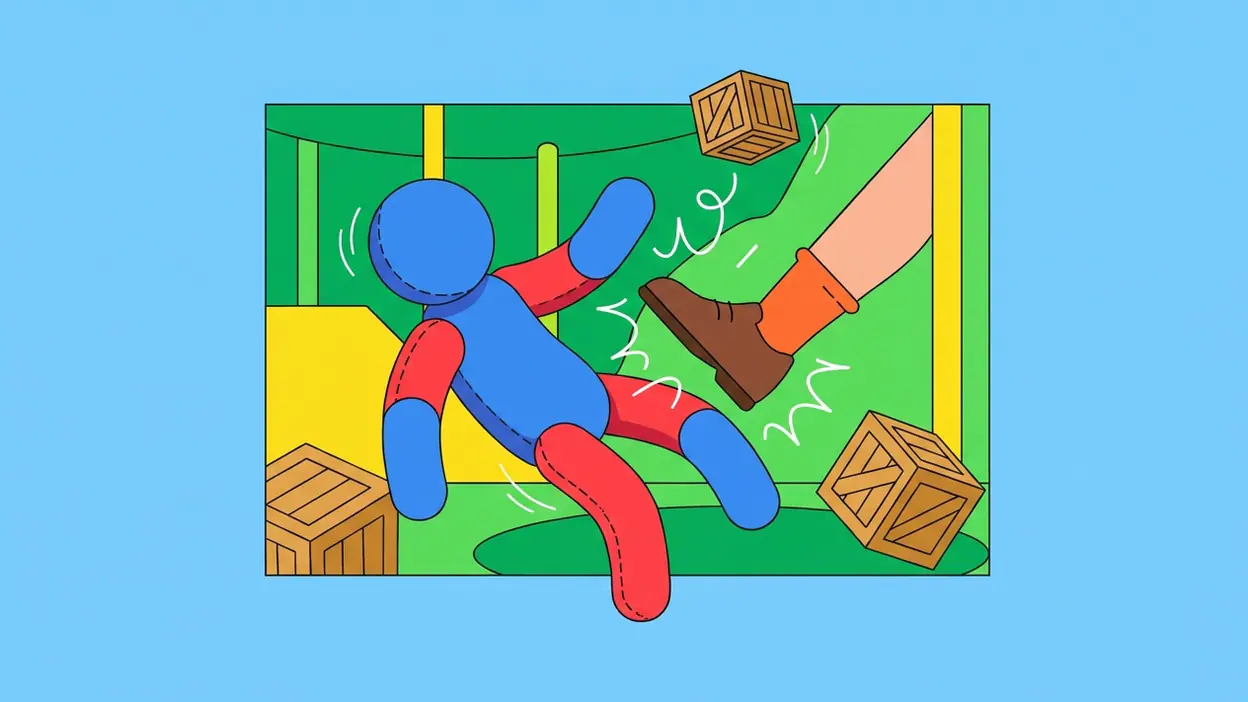
The game’s basic spectacle is legible even to someone who has never touched it. A stiff, predictable character would make each action feel like a routine animation. A ragdoll changes the bargain: movement is loose, impact looks messy, and the result can feel slightly different each time. The gap between what a player intends and what the body actually does is where the comedy lives.
That makes the game unusually well suited to a quick social clip. There is no long setup to explain, no elaborate cast to introduce and no story beat that needs context. A viewer can arrive halfway through a session, see an awkward launch or an unexpected tumble, and understand the joke. In a crowded feed, that clarity is a substantial advantage.
There is a broader mobile-game pattern here, too. Players often move between games that provide a simple, repeatable action, but the tone matters. Teacher Simulator: Exam Time gets its friction from familiar tasks and choices; Pizza Ready! turns a service routine into a steady progression loop. Kick & Break The Ragdoll Games is less about building a productive rhythm than watching a physical gag unfold. The contrast helps explain its immediate pull: it asks for very little attention before paying out a reaction.
The reaction is the product
The strongest response is usually a mix of anticipation and surprise. A player lines up an action, expects a certain kind of impact, then watches the ragdoll move in a way that looks just uncontrolled enough to be funny. Even a small change in timing or angle can make the result feel less like a button press and more like a tiny experiment.
That distinction matters. If the game only showed a fixed animation after every hit, it would quickly become a one-joke toy. The physical looseness gives players a reason to test the system: what happens if I try again from here, with a different rhythm, or after the body has landed in a new position? The pleasure is not necessarily mastery. It is the sense that the game might surprise you before you have fully understood it.
There is also a low-stakes quality to the spectacle. The violence is exaggerated slapstick, not a serious combat fantasy, and that lets the game lean into absurd outcomes rather than tension. Still, the joke needs restraint and variation. Repeating the same impact without a fresh consequence turns comic disorder into visual noise.
Compared with Melon Sandbox, which invites players to arrange and manipulate a broader sandbox of objects, this game’s identity is narrower and more direct. That focus gives it a cleaner first impression, but fewer obvious ways to surprise a player once the central interaction is familiar. Its best moments come from the physics; its biggest risk is asking physics to carry everything.
A loop that needs to keep changing
The retention hook is the promise of another outcome. The basic rhythm is compact: choose an action, watch the body react, register the result, then try again. That sequence can fit into a spare minute, which makes the game easy to reopen. It also creates a natural urge to chase a better, funnier or more extreme result.
But replay value cannot rest on the word “again.” Players need some sense of progression, whether that comes from new situations, changing objectives, unlocks, or enough variation in the play space to make old actions behave differently. Without that second layer, the loop is less a climb than a circle. The first few tries are discoveries; later tries risk becoming repetitions.
That is where the title’s simple premise becomes both a strength and a constraint. It avoids the learning burden of a complicated simulator, and it does not need players to plan several moves ahead. Yet a low barrier to entry does not automatically create a long session. The game has to keep offering reasons to test the same physical idea in a fresh way, or players will take their laugh and leave.
Annoying Uncle Punch Game® offers a useful contrast in tone: its comic aggression is framed around a recognizable character and a clear gag. Here, the ragdoll itself is the main event. That can feel more open-ended, but it also means the game has to supply enough context through play rather than relying on a character joke to do the work.
Built for clips, not necessarily conversation
Kick & Break The Ragdoll Games has the mechanics of a shareable game even when a player never presses a share button. Its payoff is visual, quick and easy to caption in a sentence. A short clip can show the setup and the punchline in seconds, and viewers do not need to know the rules before reacting.
That is the difference between streamability and streaming depth. The game can produce moments that work in a feed, but a longer broadcast needs more than isolated surprises. It needs a reason for the audience to stay: escalating challenges, viewer-led experiments, competitive targets or a player personality turning each attempt into a running joke. If those ingredients are absent, the game may perform better as a string of short clips than as a full-length watch.
Its social spread is therefore likely to be bursty. A funny result travels, a friend tries to reproduce it, and the next player looks for a more ridiculous outcome. That pattern can create a lively pocket of attention without proving that the game has durable community momentum. The distinction is important: a game can be highly clip-friendly and still struggle to sustain discussion once the novelty has circulated.
What newcomers should expect
New players should expect a light, immediate simulation built around ragdoll comedy, not a deep physics toolkit or a story-led campaign. The first session should be easy to understand: act, watch, react. If you enjoy seeing a simple input produce an unruly physical result, the appeal will make sense almost instantly.
They should also keep their expectations proportionate. This is the sort of game that can work beautifully in short bursts between longer commitments, but its moment-to-moment amusement may outweigh its long-term structure. Anyone hoping for a carefully unfolding progression system, a complex world, or a roster of characters with distinct personalities should look closely at what the game actually offers rather than assuming the slapstick premise hides a larger simulation underneath.
The best way to approach it is as a small physics playground with a clear comedic center. Try variations, enjoy the accidents, and notice whether the game gives you new circumstances to explore. If the fun depends entirely on repeating one action, there is no shame in treating it as a quick diversion rather than a daily fixture.
Does the trend have staying power?
The trend has a credible short-term engine: a recognizable gag, low effort, and outcomes that can be understood on a small screen or in a brief clip. Those qualities can carry a mobile game farther than an elaborate pitch, especially when players are looking for an uncomplicated laugh. The format also travels across audiences because there is very little cultural or mechanical context to learn.
Durability is harder to establish. A physics gag can stay amusing when the game keeps creating new situations, but the same freedom can expose thin content. If the environment, goals and consequences remain static, players will quickly learn the limits of the joke. At that point, social sharing may keep introducing the game to new people while existing players have already moved on.
The biggest cooling factors are repetition and a lack of visible evolution. A trend loses force when each clip looks interchangeable, when a session has no satisfying endpoint, or when players cannot point to a new challenge worth attempting. Even a strong first impression needs a second act. Regular additions or more varied play scenarios could extend the game’s life; without them, its momentum is likely to depend on the occasional lucky, absurd-looking result.
My editorial read is that Kick & Break The Ragdoll Games understands the fast, visual joke that gives a mobile game a chance to spread. Its core interaction is easy to grasp and naturally produces moments worth showing someone else. The question is not whether the premise works; it does. The question is whether the game can turn a laugh into a reason to return. For now, it looks like a sharp short-session diversion with viral potential, but its long-term prospects rest on variety, not just impact.


