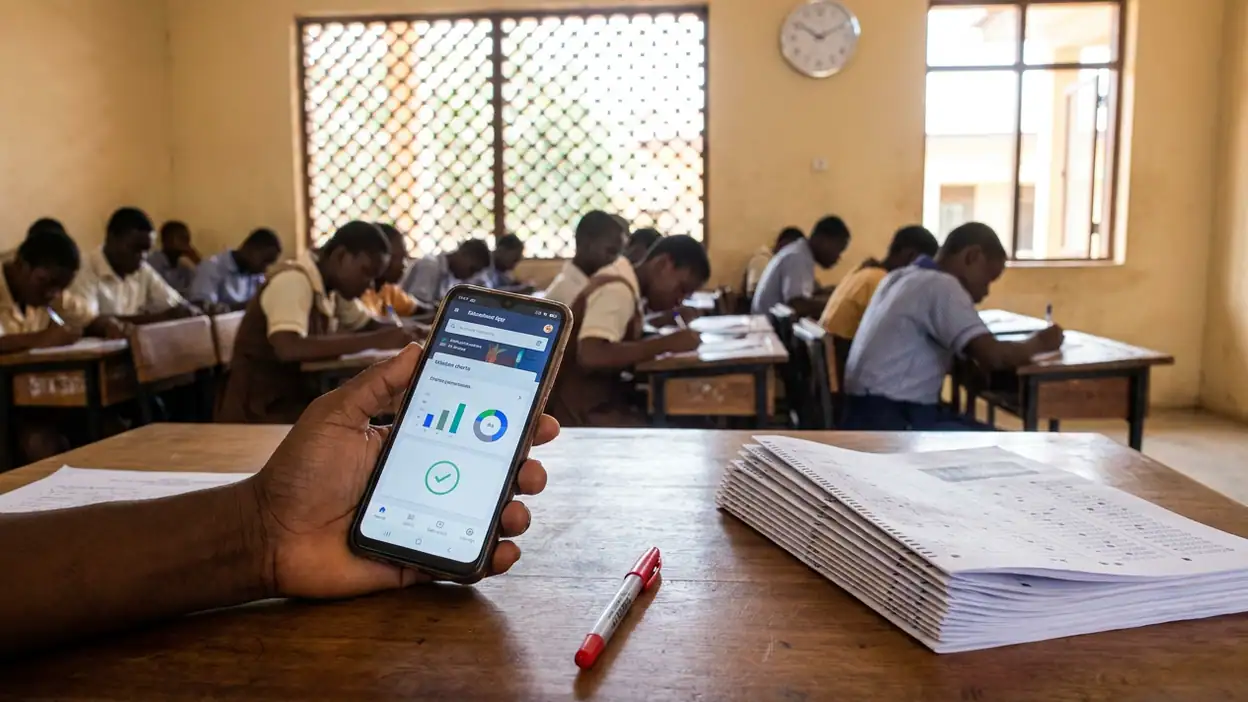
Teacher Simulator: Exam Time: Classroom Judgment as Ritual
 Analysis by Appyee
Teacher Simulator: Exam Time is built around a simple fantasy: step into the teacher’s shoes, inspect classroom behavior, mark answers, and make quick decisions that determine whether a school day feels orderly or chaotic. It is immediately readable, lightly comic, and easy to play in short bursts. Yet its most interesting community story is not found in a busy chat room or a deep multiplayer system. It is found in the way players compare judgments, share reactions, repeat familiar routines, and test the boundaries of a game that gives them authority without giving them much room to build together.
That distinction matters. This is not a social simulation in the same sense as a persistent online world, a competitive pool game, or a creator platform such as Adobe Express. Its community is largely indirect. Players gather around clips, reviews, walkthroughs, complaints about tricky questions, and the small pleasure of discovering that another person made the same call in a ridiculous classroom situation. The network value exists, but it is lightweight and dependent on conversation outside the core game. The game creates shared moments more readily than it creates a shared place.
A classroom fantasy that turns judgment into the main event
The hook works because teaching is familiar from the outside but complicated from the inside. Most players know what a classroom looks like, understand the basic idea of grading a test, and recognize the tension between a student who appears prepared and one who is clearly trying to get away with something. Teacher Simulator: Exam Time turns those assumptions into a sequence of compact decisions. You observe, choose, correct, and move on.
Its rhythm is closer to a collection of interactive sketches than to a full management simulation. A scene presents a problem, the game frames the available responses, and your choice produces an immediate result. That structure gives every decision a little theatrical weight. A correct answer feels like a small professional victory; a poor one suggests that you have misunderstood either the student, the rule, or the game’s intended sense of humor.
The result is a game that naturally invites comparison. Players do not need a guild, leaderboard, or live lobby to ask one another, “What did you choose?” That question is the beginning of its community hook. The game’s situations are short enough to describe, strange enough to remember, and subjective enough to provoke disagreement. A player can recount a classroom incident in a sentence and still leave room for someone else to argue about the right response.
The participation model is built on reaction, not collaboration
Teacher Simulator: Exam Time gives players a clear role, but not a large social role. You are the authority in the room, and the game is designed around your decisions. Other students function as characters in scenarios rather than as partners or opponents controlled by a visible community. The participation model is therefore mostly individual: play a lesson, make a judgment, earn progress, and repeat the process.
That does not make the game isolated. It makes its social layer observational. Players participate in the wider ecosystem by posting a reaction, watching someone else handle a scene, discussing whether a decision was fair, or using a short gameplay clip as a prompt for debate. The most common contribution is likely to be a response rather than a creation: a laugh, a complaint, a tip, or a claim that the game’s logic is inconsistent.
This is a much thinner model than the one found in 8 Ball Pool, where every match directly places players in competition with another person and creates a recurring reason to return. It is also unlike Google Play Books & Audiobooks, where community value is tied more quietly to reviews, recommendations, and reading habits. Teacher Simulator sits between those patterns. It has enough personality to generate discussion, but not enough shared infrastructure to make discussion essential to play.
The upside is accessibility. Nobody needs to understand a complicated social code or commit to a team schedule. The downside is that the community has no strong in-game obligation. If external conversation disappears, the game still functions almost exactly as before.
How newcomers find a way in
New players enter through the premise rather than through a community ladder. The title explains the fantasy, the opening scenarios establish the rules, and the first decisions are simple enough to make without a tutorial marathon. A player can understand the basic loop within minutes: inspect the situation, select a response, see the consequence, and continue.
That low barrier is important for community growth. A newcomer does not need a history with the series, advanced simulation knowledge, or a powerful device to understand what other players are discussing. A clip of a bizarre exam answer or a student behaving badly is self-explanatory. Someone who has never played can still understand the joke and may be tempted to try the game simply to see how they would respond.
Discovery is likely to happen through app-store browsing, short-form video, recommendation feeds, and gameplay posts rather than through formal community spaces. The game’s compact scenarios suit vertical video particularly well. A creator can show the setup, pause before the decision, and invite viewers to choose an answer before revealing the outcome. That format turns a solitary interaction into a small audience poll.
Still, the entry point has limits. Newcomers may arrive because the concept looks funny, but the game must provide enough variety to keep them after the first novelty fades. If later scenarios feel like minor variations on the same judgment exercise, the community has fewer fresh moments to circulate. The first laugh brings people in; sustained variety gives them a reason to stay.
Recurring rituals give the game its modest social pulse
The strongest rituals around a game like this are likely to be informal and repeatable. Players replay memorable scenarios, compare outcomes, and search for guidance when a decision feels unclear. They may watch a walkthrough after failing a sequence, then return to test whether the suggested answer actually produces a better result. This creates a small loop between play and explanation.
Another ritual is the “would you pass this student?” conversation. The game presents the player as a decision-maker, so every questionable answer can become a miniature ethics debate. Was the student cheating, confused, or simply unlucky? Was the teacher too strict? Did the game reward the sensible answer or the funny one? These questions are not mechanically deep, but they are socially efficient. They require little context and produce strong opinions.
Players may also develop completion rituals: clearing a set of lessons, revisiting difficult scenes, collecting rewards, or trying to improve after an earlier mistake. Those activities matter because they give a player something to report. “I finally got through that exam” is a small achievement, but it can become meaningful in a comment thread where others struggled with the same moment.
The weakness is that these rituals are not strongly reinforced by the game itself. There is no clear evidence here of a robust system for player clubs, shared classrooms, user-made exams, or persistent social status. The rituals can exist, but they depend on player initiative and the visibility of outside platforms.
What players and creators can contribute
Player contribution works best at the level of interpretation. People can explain the logic behind a choice, rank the funniest classroom situations, identify patterns in the scoring, or document the fastest route through a sequence. Even a complaint can become useful if it reveals that a scene has an unintuitive rule. In a decision-driven game, community knowledge is often less about hidden mechanics than about recognizing what the game considers acceptable behavior.
Creators have a more obvious opportunity. Teacher Simulator: Exam Time is naturally suited to reaction videos, challenge formats, and audience voting. A creator can refuse to look up answers and play as an “overly strict principal,” or invite viewers to decide whether each student deserves a pass. The game’s short scenes also make it easy to edit several decisions into a compact, comic sequence.
That creator potential should not be overstated. A game can be easy to record without being deep enough to support a long-running channel. If the scenarios do not keep escalating, the content may become repetitive. The best creator material will probably come from personality, editing, and audience participation rather than from a large underlying system.
There is also limited evidence that the developers actively support a creator ecosystem through official tools, featured community levels, contests, or detailed sharing features. Without those bridges, creators remain useful distributors and commentators, but they do not become co-builders of the game. The community can decorate the experience; it cannot clearly reshape it.
Social friction appears in the gap between fairness and game logic
Every judgment game risks irritating players when its rules are less consistent than its presentation suggests. Teacher Simulator: Exam Time asks you to behave like a responsible teacher, but the correct choice may sometimes be determined by the game’s intended punchline rather than by a complete educational principle. That gap is fertile ground for discussion and equally fertile ground for frustration.
Players tend to forgive a strange answer when the game signals that it is being playful. They are less forgiving when a result feels arbitrary. If a scenario appears to reward a choice that contradicts the visible evidence, players may describe the game as unfair rather than funny. Those complaints can bring people together, but they do not always produce a healthy community. Repeated arguments over hidden rules can turn a casual game into a small contest of certainty.
There is also the familiar friction between experienced players and newcomers. Someone who has watched walkthroughs may know the expected responses, while a first-time player is still treating each scene as a genuine judgment call. Advice can help, but spoilers can remove the very uncertainty that makes the game entertaining. A considerate community would separate hints from full solutions; an impatient one may simply post the answer.
Because the game is not built around live competition, the stakes remain low. There is no obvious reason for serious harassment over a classroom decision. Even so, comment sections and short-form platforms can magnify mockery, especially when creators frame mistakes as evidence of bad judgment. The social risk is not built into the game’s mechanics, but it can appear around the content it generates.
Moderation and safety remain mostly outside the game
The game’s offline-style decision loop limits some safety concerns. Players are not required to disclose personal information, join a voice channel, or coordinate with strangers to progress. That is a meaningful advantage for younger or more casual audiences. The core experience is comparatively self-contained.
The uncertainty begins where the community begins. If players discuss the game through public video platforms, social networks, or comment threads, the quality of moderation depends on those services rather than on the game. Spoilers, abusive replies, misleading guides, and inappropriate jokes can appear in spaces the developer does not control. Without verified information about active official moderation channels, it is difficult to claim that the surrounding ecosystem has a unified safety standard.
There is also a content question. A teacher simulator deals with authority, discipline, cheating, and student behavior. Those themes are usually presented in a light, exaggerated way, but they can still invite arguments about punishment, fairness, and stereotypes. A responsible community would keep the humor focused on the fictional scenario rather than turning real students or teachers into targets. Whether that happens consistently is impossible to confirm from the game alone.
For parents, the practical takeaway is simple: the game itself may be easier to supervise than its surrounding content. Watching a child play is one thing; monitoring every recommendation, comment section, or reaction video connected to the title is another. The absence of an intense in-game social system reduces exposure, but it does not eliminate the wider platform risks.
Where the network value actually appears
The network value of Teacher Simulator: Exam Time appears in shared interpretation. One player’s decision becomes more entertaining when another player disagrees with it. A difficult scene becomes more useful when someone explains the game’s pattern. A funny classroom moment gains a second life when a creator lets an audience vote before the outcome appears.
This is a real form of value, even if it is modest. The game supplies common reference points. Players do not need to share a large world; they only need to recognize the same scenario and understand why it produced a reaction. That makes the title well suited to casual communities, family conversations, and short-lived discussion threads.
Its network value is also strongest at the beginning of the player journey. Early discoveries are easy to share because they feel surprising. Later, once the player understands the decision grammar, the social reward depends on new scenarios or unusual outcomes. The network therefore needs a steady supply of fresh material. Without updates, events, or meaningful variation, shared discussion is likely to peak and then thin out.
This is where the contrast with Airtel: Recharge, Bank & Loans is useful. A service app earns network value through practical trust, referrals, and repeated utility; its community may be quiet, but its usefulness can deepen with routine. Teacher Simulator earns attention through spectacle and disagreement. It is more shareable, but less necessary. People talk about it because it is amusing, not because their daily lives depend on it.
That difference explains both the charm and the fragility of the ecosystem. A practical service can retain users through habit. A casual simulation must keep producing moments worth retelling.
Can the ecosystem last beyond the first wave?
Longevity depends on whether the developers treat the community as an audience or as a potential collaborator. If the game remains a fixed sequence of classroom decisions, its community may settle into a stable archive of walkthroughs and reactions. That archive can continue serving newcomers, but it will not necessarily generate much new energy.
Longer life would require more than additional scenes. Seasonal exam themes, rotating challenges, branching consequences, or community-voted dilemmas could give players a reason to return together. A user-created question system would be even more powerful, provided it included strong moderation and clear limits. Players could then contribute not only opinions about the game but material for the game itself.
However, those features would change the safety and design burden substantially. User-generated classroom scenarios would need review. Competitive grading would need protection against cheating and harassment. Shared progression would need rules that prevent experienced players from overwhelming newcomers. The current simplicity is part of the game’s appeal, and a larger ecosystem could easily make it noisier without making it better.
The more realistic path is a small creator-friendly ecosystem rather than a full social platform. Better sharing tools, spoiler controls, challenge codes, and occasional official prompts could give players more reasons to compare results while preserving the clean solo loop. The game does not need to become a virtual school district. It needs a few reliable bridges between private play and public conversation.
There is no clear basis for promising that such a network already exists at scale. Community activity can vary by region, platform, update cycle, and creator interest. Any claim of a large, highly organized player base would need direct evidence. What can be said with confidence is that the game’s format makes lightweight participation easy, while its current structure appears less suited to sustained collective projects.
The community verdict
Teacher Simulator: Exam Time has a community hook because it turns ordinary authority into a series of debatable moments. Players can compare choices, laugh at absurd classroom logic, trade hints, and invite audiences to judge alongside them. Those interactions give the game more life than its solo mechanics might suggest.
But the ecosystem remains peripheral rather than foundational. The game does not appear to depend on player cooperation, creator-made content, or a persistent social identity. Its community is a ring around the classroom, not a classroom shared by everyone. That is not a failure; it is an accurate description of the product’s scale and ambition.
For newcomers, the low-friction entry is a strength. For creators, the decision format provides clean material for reaction and voting videos. For regular players, the main reward is the pleasure of comparing judgment with other people. The weak points are equally clear: limited evidence of official community infrastructure, uncertain moderation outside the game, and a risk that repeated scenarios will exhaust their social novelty.
My verdict is that Teacher Simulator: Exam Time works best as a conversation starter, not as a community destination. It gives players enough shared material to form small rituals, but not enough collaborative depth to sustain a powerful network on its own. If future updates add meaningful variation and safer sharing tools, the game could turn its scattered audience into a more durable ecosystem. As it stands, its social life is enjoyable precisely because it stays light: play alone, make a questionable call, then find out whether everyone else would have done the same.


