Temple Run and the Endless Runner’s New Rules
 Analysis by Appyee
The most revealing thing about Temple Run is not that it still makes a missed turn feel like a small disaster. It is that the game can make a familiar path feel urgent with so little: a runner, a pursuing monster, and a corner arriving before you are ready. That stripped-down chase helped define the endless runner. It also gives us a sharp way to see what the category now expects, and what its older formula no longer supplies on its own.
Temple Run remains a potent test of arcade design because its central promise is so clear. You are not building a base, planning a route, or learning a complicated combat system. You are trying to stay alive a few seconds longer, gather more coins, and turn a clean run into a better one. The genre has expanded around that promise, but its strongest games still depend on the same basic contract: instant understanding, fast feedback, and a reason to restart.
The runner’s baseline has moved
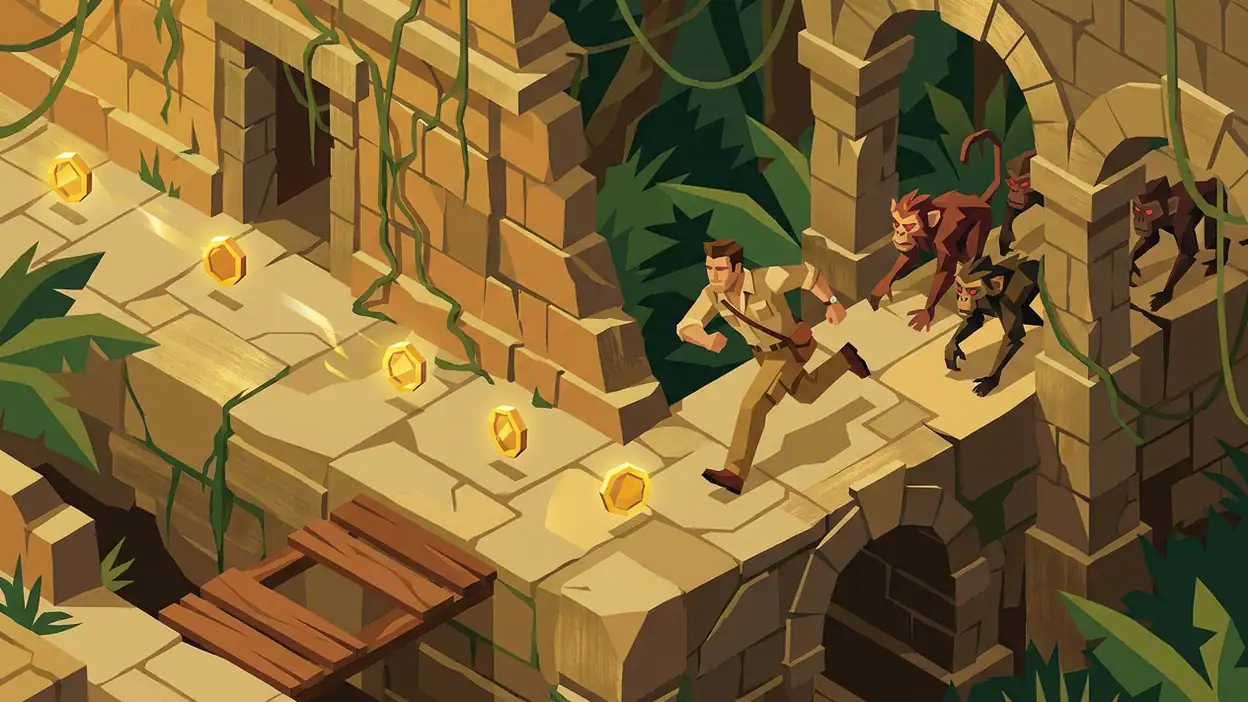
Temple Run’s opening is a masterclass in readable pressure. The camera sits behind the fleeing explorer as the path threads through ancient ruins. Swipe to turn, jump, or slide; tilt to steer toward coins. The controls are easy to explain, but the road quickly complicates them with gaps, low beams, sharp bends, and broken bridges. You learn by reacting, and every mistake is legible. That clarity remains the baseline for the category.
Today, though, simple controls are only the entry fee. Players expect a runner to make its first minute frictionless, then give them reasons to return beyond beating a personal distance record. That can mean unlockable characters, upgrade paths, missions, changing environments, or events that give a familiar run a fresh target. A good runner still asks for quick reflexes, but it also needs a longer rhythm: short sessions that add up to a sense of progress.
That longer rhythm changes the meaning of replay value. A run can be satisfying in itself, but a player may also want to feel that coins are working toward something, that a new challenge is within reach, or that a different character changes the mood. The category’s current baseline is not simply “easy to pick up.” It is easy to pick up, hard to exhaust.
Temple Run understands the first half better than almost anything. Its second-to-second pacing has a wonderfully physical quality. A turn arrives, the thumb flicks, the character snaps around the corner, and the pursuit keeps pressing. Long stretches invite concentration; sudden hazards break it. A successful run develops a pulse of its own, alternating between brief calm and sharp correction.
The central chase is also an unusually economical hook. The demon monkeys are not a menu animation or a story detail you can ignore; they make failure feel like being caught. Their presence gives the opening seconds a clear dramatic shape, then turns the road into a test of nerve. When the path narrows and the camera seems to rush toward the next obstacle, you are not just collecting points. You are trying to keep the pursuers behind you.
That is the game’s strongest signal to the rest of the category: the best arcade pressure is instantly readable and emotionally legible. Players do not need a long explanation of why a run matters. The danger is on screen, the next move is obvious, and the cost of hesitation is immediate. It is a compact loop with no dead air.
What the old formula still gets right
Temple Run follows the classic runner conventions with admirable discipline. Its path keeps moving forward, its obstacles demand quick, simple inputs, and its collectible coins make small route choices feel worthwhile. You can chase a safer line or lean toward a richer one, balancing survival against reward. That tradeoff adds a flicker of strategy without slowing the action into a different kind of game.
The score also does useful work. Distance, coins, and survival combine into a result that invites another attempt. A failed run is rarely mysterious: perhaps you mistimed a jump, drifted too far while steering, or reacted to one hazard and forgot the next. That clarity matters. Arcade games thrive when failure feels like information rather than a verdict from an unpredictable system.
But the same discipline can become repetition. Once you know the gestures and have seen the core obstacle vocabulary many times, the road’s surprises begin to feel like variations on a familiar sentence. The game can still produce tense runs, especially as speed rises, but tension is not the same thing as novelty. A sharper challenge does not automatically create a richer world.
This is where the convention Temple Run challenges is the assumption that an endless road is enough. The road provides a dependable testing ground, yet endlessness can flatten a game if it does not keep changing what the player is doing or why. A faster version of the same sequence may demand more skill, but it may not create a fresh decision. The original formula exposes the difference between “more difficult” and “more interesting.”
Peers point toward a broader arcade
Related mobile games show how widely the arcade label has stretched. Subway Princess Runner uses the familiar forward-running framework, but its surface and presentation lean into a more contemporary, character-led identity. Its relevance to Temple Run is not that one replaces the other; it is that a basic runner now competes in a crowded field where visual character and immediate appeal help a game earn that first tap.
Zombie Tsunami takes a different route, turning the player’s growing group of zombies into the central spectacle. Its appeal comes from accumulation and chaos rather than the solitary escape at the heart of Temple Run. That contrast makes a category shift visible: an arcade game can keep the input simple while changing the fantasy and the shape of the reward. The control scheme is not the whole identity.
Stack Ball - Crash Platforms demonstrates another way to make a small interaction carry a whole session. Its appeal is built around the satisfying release of smashing through layers, a direct action-and-feedback loop that does not depend on a running track. Cooking Fever: Restaurant Game is further removed, but its timed orders and upgrade economy underline how much modern mobile arcade play relies on goals that continue beyond one attempt. Blockman Go, with its broader social and mode-based framing, points to an expectation that a mobile game can be a place to spend time, not only a single mechanic to repeat.
These games are not all direct rivals, and treating them as interchangeable would miss the point. Together they show a category moving away from a narrow definition based on reflexes alone. Players now encounter arcade games with distinct fantasies, multiple activity loops, and progression that can shape the next session. The standard has widened: a strong core mechanic matters, but it is increasingly expected to sit inside a more personal and varied package.
Temple Run’s restraint remains a virtue. It does not bury its chase under systems that delay the fun. Yet the contrast with these neighboring games makes its limitation plain: the run itself has to carry nearly all of the entertainment. If the player wants a new kind of decision, a richer social layer, or a different activity, the original loop has little to offer beyond another attempt.
The emerging standard is therefore not “add more features.” That would be an easy, and often clumsy, reading. It is to make variety serve the core loop. New goals should alter how a player approaches a run; new settings should change its visual and tactical texture; unlocks should feel connected to the play rather than tacked onto it. The strongest arcade games preserve instant access while giving repeated sessions different reasons to exist.
Where the category still falls short
Mobile arcade games have made progress in onboarding and progression, but the category can still confuse retention with repetition. A trail of missions and rewards may keep a player checking in without making the underlying play more expressive. Endless runners are especially vulnerable: once the hazards and inputs are familiar, a longer distance can feel like a measurement of endurance rather than a new experience.
Temple Run shows the other side of the problem. Its focused design protects the pace, but it leaves limited room for the player to express a preferred style. You can steer toward coins and improve your timing, but the run does not open into many fundamentally different approaches. Its clarity comes with a narrow range of decisions, and the sharpness of its original idea can make later repetition more noticeable.
There is also a limit to what escalating speed can fix. When a game gets faster, a mistake can feel more dramatic, but repeated visual patterns may become harder to read rather than more interesting. A runner needs to test attention without making its obstacles feel like arbitrary punishment. The category still has work to do in balancing challenge, legibility, and genuine variation.
For players, this shift means the best choice depends on what they want from a short session. Temple Run is still an excellent pick for clean, immediate tension: launch it, find the rhythm, and see how long your reflexes hold. Someone looking for broader goals or more changing activities may gravitate toward games that build progression or variety more deeply into the experience. The classic remains useful precisely because it makes that choice easy to understand.
Temple Run has not become a model that every runner should copy in full. It is a model of what a core loop can achieve when every gesture, hazard, and reward points toward the same urgent purpose. Its lasting value is not that endless runners should stay frozen in their early form, but that added systems cannot rescue a weak chase. The category’s next step is to keep Temple Run’s instant pulse and give players more meaningful reasons to return. The road still works; it just needs to lead somewhere more surprising.


