Why Toca Boca World Makes Open-Ended Play Feel Like Learning
 Analysis by Appyee
Children’s mobile games used to make a fairly simple promise: tap the right thing, learn a fact, finish a coloring page, and move on. Toca Boca World makes that promise feel dated. Its real achievement is not that it teaches through play, but that it treats play itself as a form of learning: arranging a room, inventing a character, staging a family dinner, or turning an ordinary shop into a story set. The category is shifting from digital worksheets toward flexible worlds, and Toca Boca’s game is one of the clearest signs of where the standard is heading.
That does not make it flawless. The game can feel expensive once its larger catalog is considered, its open-ended design may frustrate children looking for obvious goals, and its educational value is often indirect rather than measurable. Still, after spending time moving characters through apartments, shops, restaurants, schools, and public spaces, I came away convinced that its most important feature is the space it leaves unfinished. The child supplies the purpose.
The category is leaving the worksheet behind
Educational games have traditionally been built around controlled outcomes. Coloring apps ask children to fill a bounded shape. Early-learning games present a sequence of letters, numbers, puzzles, and rewards. Even the better examples tend to define success in advance. That structure is useful, especially for short practice sessions, but it also narrows the imagination. A child learns how to complete the activity the developer prepared, not necessarily how to decide what an activity could become.
The newer expectation is broader. Parents increasingly want an app that is safe, visually gentle, and easy to understand, but they also want something a child can revisit without being pushed through a lesson plan. Children, meanwhile, expect the freedom they see in other forms of play: customization, collecting, role-play, and worlds that respond to their choices. The strongest products now have to satisfy both audiences without making the child feel as if a lesson is hiding behind every tap.
That is where the educational category is advancing. Learning is being measured less by the number of correct answers and more by the quality of the child’s engagement. Does the game invite language? Does it encourage sequencing, pretend roles, spatial reasoning, or social negotiation? Does it support a story that lasts longer than a single task? These are softer outcomes, but they are not trivial. They describe the mental work children perform when they organize a world of their own.
The baseline has become much higher
Today, a children’s app cannot rely on bright colors and cheerful sound effects as its main design argument. The baseline now includes readable interactions, forgiving controls, clear privacy practices, limited advertising, and an interface that a young child can understand without constant adult rescue. Accessibility matters too: adjustable sound, low-pressure pacing, and visual clarity make a difference to families with different needs.
There is also a new expectation of emotional safety. A good children’s game should not punish curiosity with sudden timers, aggressive purchase prompts, or noisy reward loops. It should allow a child to pause, repeat, make a mess, and return later. That sounds obvious, yet many products still borrow the pressure systems of mainstream mobile games. The educational label does not automatically make a design child-friendly.
Against this baseline, Toca Boca’s world feels deliberately unhurried. Characters can be dragged, dressed, fed, placed, and removed with little risk of failure. Objects usually behave in ways that are easy to test. A child can open a cupboard, move food onto a plate, put a hat on a character, or carry an item across a location simply because the possibility is there. The game rarely insists that one action is the correct one.
That approach is not just a pleasant interface choice. It changes the rhythm of play. Instead of scanning the screen for the next target, I found myself watching what a child might notice: a refrigerator full of ingredients, a bed that can be rearranged, a bathroom cabinet with objects that can be handled, or a shop shelf that quietly suggests a new scene. The game’s content is often less important than the relationships between its objects.
The strongest signal is the world, not the lesson
The central signal from Toca Boca is that a children’s game can be educational without presenting itself as a classroom. Its city is a collection of prompts rather than a curriculum. A restaurant can become a setting for ordering and sharing food, but it can also become a stage for conflict, comedy, or a completely invented routine. A home can support vocabulary about rooms and objects, yet its deeper value comes from letting children decide who lives there and what happens next.
This is where the game’s loop becomes distinctive. The hook is discovery: what can be touched, moved, opened, worn, or combined? The immediate loop is arrangement and role-play. The longer rhythm is returning to a familiar place with a new idea. Replay value does not come from increasingly difficult levels. It comes from the fact that the same room can support a different story tomorrow.
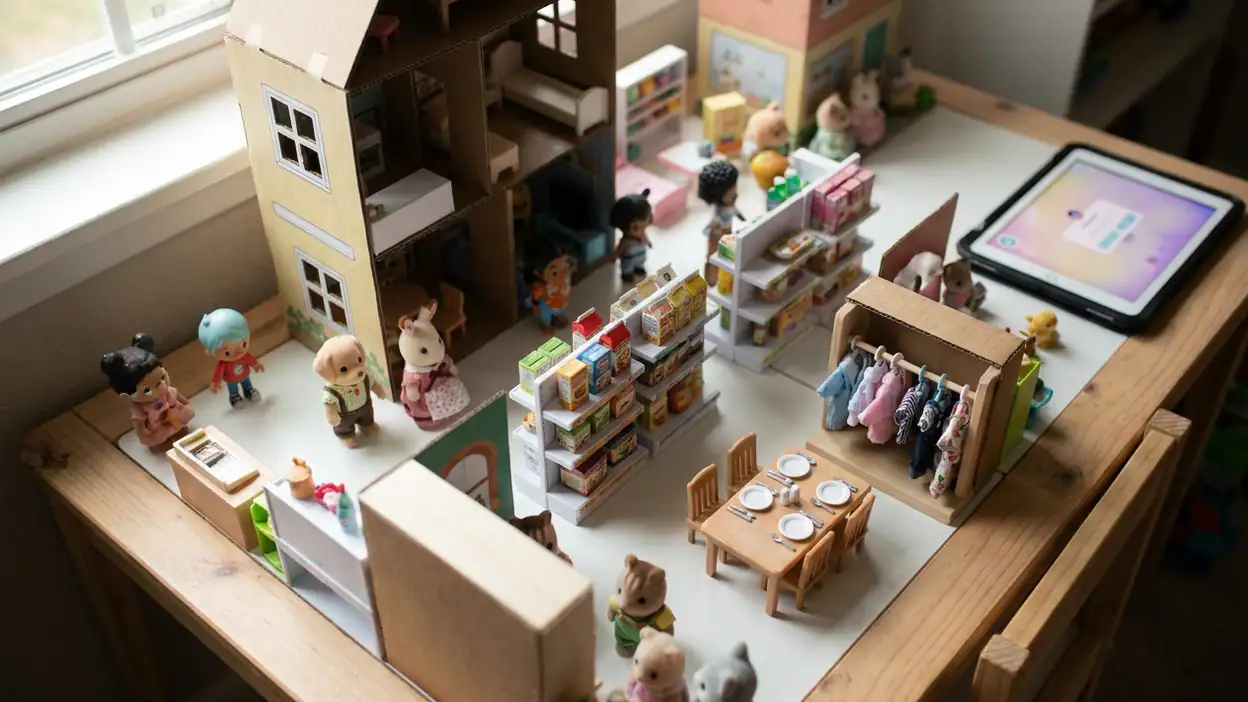
I tested that rhythm by treating the locations less like levels and more like a small production studio. Characters became shopkeepers, customers, parents, students, and visitors. Food moved from kitchen to table, objects changed hands, and rooms acquired temporary purposes. None of this required a score. The pleasure came from making the world coherent for a few minutes, then breaking that coherence to start another scenario.
Open-ended play is the product’s educational engine. It develops sequencing because actions have to be arranged. It encourages expressive language because stories need names, motives, and explanations. It supports social play when children negotiate who controls which character or decides what happens next. These benefits are not guaranteed every time, but the design creates room for them in a way a fixed coloring task usually cannot.
The conventions it follows
Toca Boca World still belongs unmistakably to the children’s mobile game tradition. It uses friendly character design, bold environments, simple gestures, and immediate visual feedback. The game avoids complex menus and keeps most actions close to the object being manipulated. That familiarity is important. A child does not need to understand a deep rule system before beginning, and an adult can usually explain the basics in a sentence.
It also follows the category’s reliance on collectible content. New locations, furniture, clothing, characters, and themed environments expand the available play space. This is a practical way to keep a world fresh, and it gives families a reason to return. Yet it also introduces the commercial structure that many parents will notice: the core experience is accessible, while the larger universe can become a series of paid additions.
That model is less intrusive than the energy systems, countdowns, and competitive monetization found in many mainstream mobile games. Still, the distinction between a generous starter world and a fully satisfying catalog matters. Children do not experience content as a business model. They experience a locked room, a missing costume, or a location they cannot enter. The game’s calm tone does not erase that friction.
The game also follows the convention of using repetition as comfort. Locations remain recognizable, controls remain stable, and objects tend to behave consistently. For young players, this predictability is valuable. It reduces cognitive load and lets experimentation become the focus. The risk is that familiarity can become stillness if new content only adds more things without deepening what those things can do.
The convention it challenges
The sharpest challenge is to the idea that educational progress must be visible as a sequence of completed tasks. In Toca Boca World, there may be no badge proving that a child has mastered a concept. There is no final screen announcing that imaginative play has been finished. The game trusts that inventing a scenario, revising it, and explaining it can be worthwhile even when nothing is scored.
That is a bold choice because it makes the product harder to evaluate with simple metrics. A parent can count completed puzzles in a phonics app. It is harder to count the value of a child spending twenty minutes arranging a household, assigning roles, and narrating an imaginary emergency. The activity is less legible, but it may be closer to how children naturally practice communication and social understanding.
The challenge extends to the usual definition of replayability. In a level-based game, replay means trying to improve a result. Here, replay means trying a different interpretation. The child is not necessarily getting better at the same task; the child is becoming more ambitious, more detailed, or more inventive in the stories created. That is a quieter form of progression, and it asks adults to pay attention to behavior rather than statistics.
There is a trade-off. Some children need stronger scaffolding than the game provides. Without a suggested activity, a young player may simply move objects around for a while and then leave. The absence of goals can feel liberating to one child and empty to another. Toca Boca’s design is strongest when an adult occasionally joins in with a prompt, but that means the game’s educational potential is partly dependent on the surrounding conversation.
What related products reveal
Comparing Toca Boca World with Coloring Games: Color & Paint and Coloring & Learn clarifies the shift in category standards. Coloring apps remain excellent at delivering a focused, low-friction activity. They can support color recognition, hand control, and concentration, and their boundaries make success immediately understandable. But their replay value usually depends on a large supply of pages or visual effects. Once the page is filled, the central problem has been solved.
Toca Boca’s scenes behave differently. They do not end when the screen looks complete. A room can be redressed, a character can change roles, and an object can be reused in a new context. The game therefore places more weight on interpretation than completion. Coloring apps are still useful tools, but they represent the older baseline: one activity, one result, one clear endpoint.
Fluvsies - A Fluff to Luv points toward another branch of the category: care and attachment. Feeding, cleaning, dressing, and looking after a virtual creature can teach routine and responsibility through repetition. Its appeal comes from the emotional bond between player and pet. Toca Boca World borrows some of that role-play energy but distributes it across a whole cast. Instead of one creature needing care, an entire social environment can be organized and reimagined.
Baby Panda World-Learning Game and Baby Panda’s School Bus show the continuing strength of guided learning. Their activities tend to frame knowledge through recognizable themes, short tasks, and direct feedback. That structure works well for children who benefit from clear instructions or for parents seeking a specific learning objective. It also exposes the category’s unresolved split: should a children’s app behave like a playful lesson, or like a toy that happens to support learning?
Toca Boca’s answer is firmly on the toy side. The advantage is freedom and longevity. The limitation is that its educational outcomes are less explicit. Taken together, these related products suggest that the market is not replacing structured learning with open-ended play. It is developing two complementary standards: guided activities for targeted practice and flexible worlds for imagination, language, and social rehearsal.
The emerging standard is meaningful agency
The category’s next standard will not simply be more content. It will be meaningful agency: the sense that a child’s choices change the experience in understandable ways. That does not require complicated simulation. It can mean allowing objects to be used in several contexts, letting characters express different roles, preserving a child’s arrangements, and making the world responsive without becoming chaotic.
Toca Boca World already demonstrates why agency matters. A character is not locked into one identity. A kitchen is not only a kitchen. An outfit is not merely a reward. These elements become useful because the player can connect them. The game’s design encourages children to think in systems, even if those systems are small: people need places, places contain objects, objects can support actions, and actions can produce stories.
Future educational games will likely borrow this structure while adding better support for different kinds of play. A child might receive optional story starters, collaborative modes with strong safety controls, or gentle prompts that turn free play into a conversation about emotions and consequences. The best versions will avoid converting every imaginative act into a quiz. They will make the possibilities easier to discover without taking ownership away from the player.
Personalization will matter as well, but it should be handled carefully. Customization is valuable when it lets children see themselves in the world or express a preference. It becomes less valuable when it is mainly a reason to sell more items. The emerging standard will distinguish between content that expands expression and content that merely increases the size of a catalog.
Where the category still lags
Even the strongest open-ended children’s games have weaknesses that the industry has not solved. The first is adult visibility. Parents need clearer ways to understand what a child is doing without turning play into a report card. A useful product might offer optional summaries of themes explored, time spent, or creative prompts used, while avoiding the pressure to quantify imagination.
The second is accessibility. Simple drag-and-drop controls help many players, but motor, visual, auditory, and cognitive differences require more than simplicity. Adjustable interaction speed, stronger contrast options, alternative input methods, and flexible sound design should become ordinary features rather than special considerations. A world built around agency should give more children genuine access to that agency.
The third is monetization. Children’s games can be calm, safe, and artistically thoughtful while still placing families in a difficult purchasing environment. Clear pricing, sensible bundles, and a meaningful free experience are not minor details. They shape trust. If the category wants parents to value imaginative play as a long-term activity, it cannot make that activity feel like a sequence of small negotiations at the point of purchase.
There is also a content problem. Adding locations is easier than adding depth. A new room may look attractive, but the more important question is whether it creates new relationships, new forms of storytelling, or new ways to solve a problem. The category will mature when developers measure the quality of possibilities, not just the quantity of assets.
What this means for children and families
For children, the consequence is encouraging: the best mobile games are becoming less interested in telling them what to do every second. They are making room for experiments that do not need to be correct. That can support confidence, especially for children who dislike failure-based games or who prefer to communicate through pretend play rather than direct questioning.
For parents, the consequence is more complicated. Choosing a good educational game now requires looking beyond labels such as learning, creativity, or preschool. The useful questions are more specific. Can the child make meaningful choices? Does the game respect attention rather than exploit it? Are there enough systems to support repeated play? Can an adult join without taking over? Does the product remain valuable when the novelty fades?
Toca Boca World scores well on those questions because its core interaction is generous. It lets children handle the world before they understand all its possibilities. I appreciated that the game rarely made me feel rushed, and I could see how a child might use it alone for a short imaginative session or with a sibling as a shared storytelling space. Its best moments are not spectacular. They are small scenes that a child has arranged and then decided are worth continuing.
But families should also understand what it is not. It is not a replacement for a reading program, a numeracy tool, or a structured classroom activity. It will not reliably teach a defined sequence of academic skills without help from an adult. Its educational value is broader and less measurable: language, pretend roles, planning, emotional rehearsal, and the confidence to make something up.
The outlook for educational mobile games
The category is heading toward a useful tension between structure and freedom. Guided apps will remain important because children need practice with concrete skills. Open worlds will grow because children also need spaces where they can decide what matters. The strongest products will not force one model to replace the other. They will know when to provide a prompt and when to step back.
That balance will raise the bar for design. Developers will have to create worlds that are easy to enter but deep enough to revisit, monetized without undermining trust, and expressive without becoming confusing. They will need to treat sound, pacing, accessibility, and privacy as part of the learning experience rather than technical details around it.
Toca Boca World is valuable because it makes the change visible. Its city may look like a collection of cute places and movable objects, but underneath is a serious argument about childhood play: learning does not always arrive as an instruction. Sometimes it appears when a child decides that a supermarket is a spaceship, a bedroom is a hospital, and a handful of characters have a problem that needs solving.
The future of educational mobile games will belong to products that understand that distinction. A worksheet can teach a child how to finish. A well-designed world can teach a child how to begin. Toca Boca World is not the final answer, and its paid expansions and lack of explicit goals deserve scrutiny, but it points toward a healthier category standard: less pressure, more agency, and play that remains valuable because the child, not the app, decides what happens next.


